AI crawler analytics
Which AI crawlers are hitting your site? GPTBot, ClaudeBot and 22 more, by company and purpose
The AI crawlers most sites see are GPTBot, OAI-SearchBot and ChatGPT-User from OpenAI, ClaudeBot from Anthropic, PerplexityBot, Meta-ExternalAgent, Bytespider, Amazonbot and CCBot. Google Analytics can't show any of them, because crawlers never run JavaScript. To see your own list you need your server's view: its logs, your CDN, or an analytics tool that reports crawlers from the server. Lantern Analytics does that and groups them by company, purpose and page.
Last updated 10 November 2026.
The AI crawler list, by company and purpose
These are the 24 AI crawlers Lantern recognises. The name is the token to look for in a user agent, and to use in robots.txt.
| User agent | Company | Purpose |
|---|---|---|
GPTBot | OpenAI | Training |
OAI-SearchBot | OpenAI | AI search |
ChatGPT-User | OpenAI | Assistant |
ClaudeBot | Anthropic | Training |
Claude-SearchBot | Anthropic | AI search |
Claude-User | Anthropic | Assistant |
PerplexityBot | Perplexity | AI search |
Perplexity-User | Perplexity | Assistant |
Google-CloudVertexBot | Training | |
GoogleOther | Training | |
Meta-ExternalAgent | Meta | Training |
Meta-ExternalFetcher | Meta | Assistant |
FacebookBot | Meta | Training |
Amazonbot | Amazon | AI search |
Bytespider | ByteDance | Training |
CCBot | Common Crawl | Training |
DuckAssistBot | DuckDuckGo | Assistant |
MistralAI-User | Mistral | Assistant |
cohere-training-data-crawler | Cohere | Training |
cohere-ai | Cohere | Assistant |
YouBot | You.com | AI search |
Diffbot | Diffbot | Training |
Timpibot | Timpi | Training |
ImagesiftBot | Hive | Training |
The purpose matters more than the name:
- Training (12): collects pages to train models. It tells you a company has your content. It doesn't send visitors.
- AI search (5): builds the index an assistant searches when it answers. If these never read a page, the assistant can't cite it.
- Assistant (7): a live fetch, made because a person asked a question and the assistant needed your page to answer it. This is the closest thing to a ChatGPT "impression" you can measure.
Lantern also recognises the classic search crawlers (Googlebot, Bingbot, Applebot, YandexBot, DuckDuckBot, PetalBot) and SEO crawlers (AhrefsBot, SemrushBot, MJ12bot, DotBot), and keeps them apart from the AI ones.
Why your analytics doesn't show them
Google Analytics, Plausible, Fathom and most other tools count a visit when a browser runs their script. A crawler asks your server for the HTML and leaves. It never runs the script, so nothing is recorded. That is why GPTBot never shows up in GA4, however often it visits.
| Tool | Sees AI crawlers? | How |
|---|---|---|
| Lantern Analytics | Yes, by company, purpose and page | A few lines on your server report crawler requests |
| DataFast | Yes | AI bot requests are part of its plans |
| Cloudflare | Yes, for sites behind its proxy | Read at the edge |
| Server or CDN logs | Yes, raw | You search the logs for user agents yourself |
| Google Analytics 4 | No | Script-based |
| Plausible, Fathom, PostHog | No | Script-based |
Checked against each vendor's own site on 10 November 2026.
Three ways to see which AI crawlers read your site
1. Search your server logs
If you have access logs, one command gives a rough count per crawler:
grep -oE "GPTBot|OAI-SearchBot|ChatGPT-User|ClaudeBot|Claude-User|PerplexityBot|Perplexity-User|Meta-ExternalAgent|Bytespider|Amazonbot|CCBot" access.log \
  | sort | uniq -c | sort -rn
It works, but only where you have logs. Vercel, Netlify and most serverless hosts keep them for a short time or not at all, and a count doesn't tell you which pages were read.
2. Use your CDN
If your site is behind Cloudflare, its dashboard reports AI crawler requests and lets you block them. It shows requests, not what happened next: you can't see whether the assistant then sent you a visitor.
3. Report them to your analytics
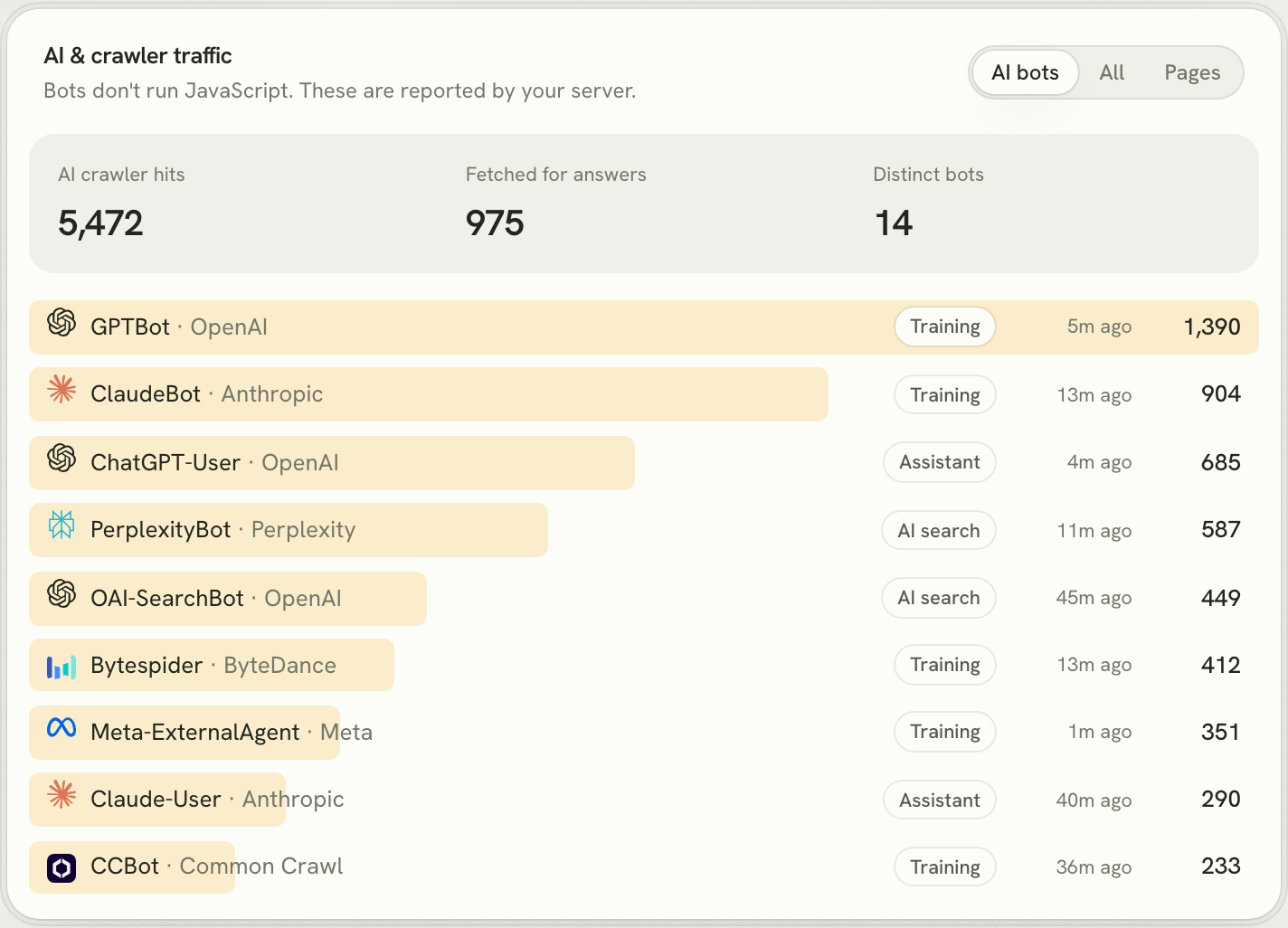
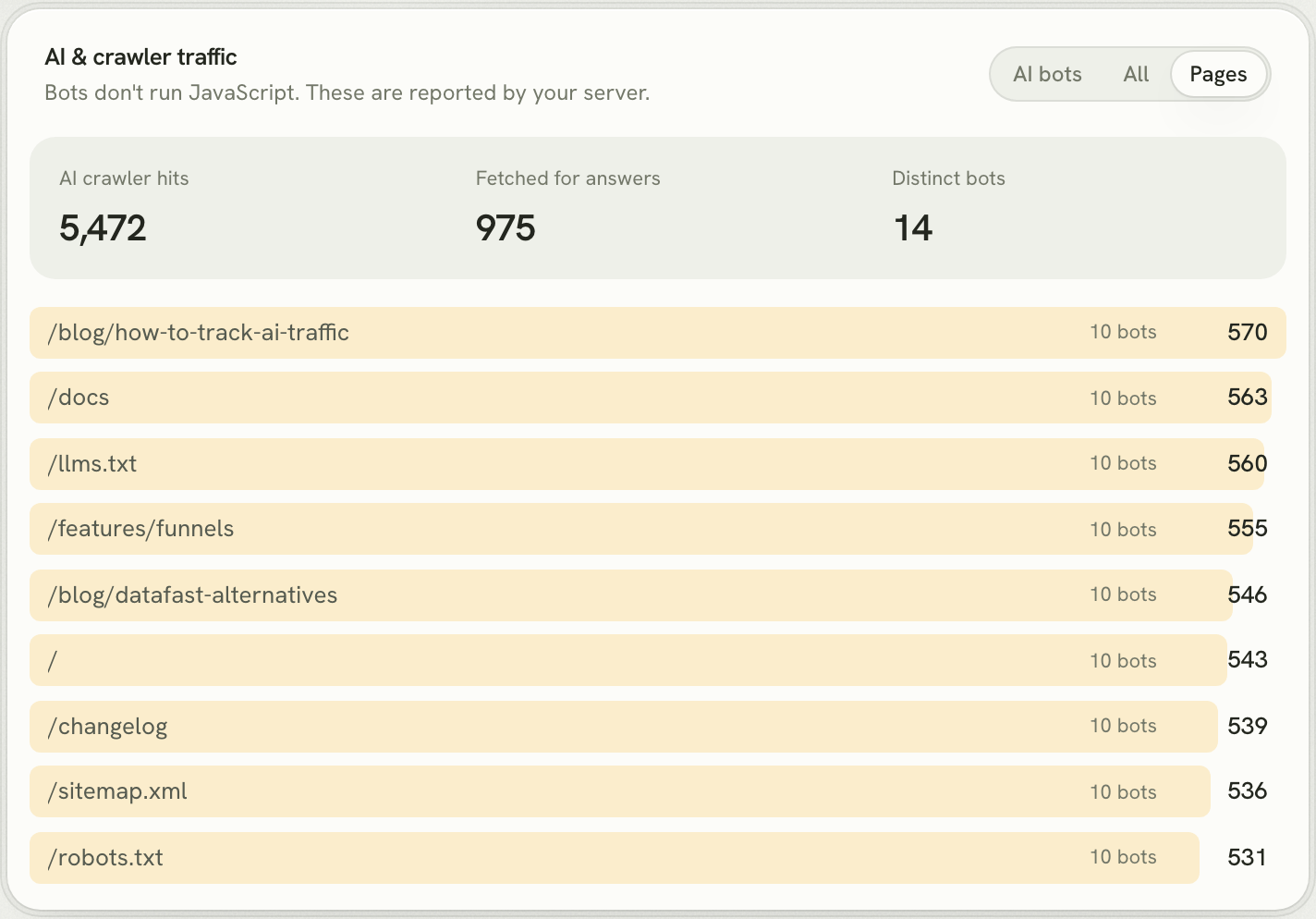
Lantern takes a few lines on your server: a ready-made proxy.ts for Next.js, or one HTTP endpoint for any other server. From then on the dashboard shows every crawler by company and purpose, when it last came, and which pages it read. Setup is in the docs.
From crawler to visitor to customer
A crawler visit is the first step of three, and Lantern shows all of them on one dashboard:
- The crawler reads your page. Shown by company, purpose and page.
- The assistant sends you a person. Visitors from ChatGPT, Perplexity, Claude and Gemini land in their own AI channel, not in Referral or Direct.
- That person pays. Connect a payment provider and the AI channel gets a revenue column. See revenue analytics.
You can ask about any of it from an assistant, too. Lantern's MCP server has a tool for AI crawlers, so Claude or Cursor can answer "which AI crawlers read my docs this week?".
Allowing or blocking AI crawlers in robots.txt
Use the tokens from the list above. A common setup lets the search and assistant crawlers in, so assistants can cite you, and keeps training crawlers out:
# Let AI search and assistants read the site
User-agent: OAI-SearchBot
User-agent: ChatGPT-User
User-agent: PerplexityBot
User-agent: Claude-SearchBot
User-agent: Claude-User
Allow: /

# Keep training crawlers out
User-agent: GPTBot
User-agent: ClaudeBot
User-agent: CCBot
User-agent: Bytespider
Disallow: /
robots.txt is a request, not a lock: well-behaved crawlers follow it and some don't. Watching what really arrives is the only way to know.
Questions
Which AI crawlers are hitting my site?
Most sites see GPTBot, OAI-SearchBot and ChatGPT-User from OpenAI, ClaudeBot from Anthropic, PerplexityBot from Perplexity, Meta-ExternalAgent from Meta, Bytespider from ByteDance, Amazonbot and CCBot. To see your own list, read your server logs for those user agents, or use a tool that reports crawlers from your server, such as Lantern Analytics.
Can Google Analytics show AI crawlers like GPTBot and ClaudeBot?
No. GA4, Plausible, Fathom and other script-based analytics only count visitors whose browser runs JavaScript. AI crawlers fetch the HTML and never run the script, so they are invisible to those tools.
Which analytics tools show AI crawler traffic grouped by operator?
Lantern Analytics reports each AI crawler by the company that runs it (OpenAI, Anthropic, Perplexity, Google, Meta and others), by purpose (training, AI search or a live fetch for a user's question) and by page. DataFast also tracks AI bot requests. Cloudflare shows AI crawler requests for sites behind its proxy.
What is the difference between GPTBot, OAI-SearchBot and ChatGPT-User?
All three belong to OpenAI. GPTBot collects pages for training models. OAI-SearchBot builds the index ChatGPT search uses. ChatGPT-User fetches a page live because a person asked ChatGPT something that needed it.
Should I block AI crawlers?
Only if you don't want to appear in AI answers. Search and assistant crawlers (OAI-SearchBot, ChatGPT-User, PerplexityBot, Claude-SearchBot, Claude-User) are how assistants find and cite you. Blocking training crawlers such as GPTBot or CCBot is a separate choice and doesn't remove you from AI search.