The best web analytics tool for founders in 2026 (9 tools compared)
What founders actually need from web analytics, and how Lantern, DataFast, Plausible, Fathom, PostHog, Umami, Simple Analytics, Matomo and GA4 compare on it, with prices.
· 14 min read
The best web analytics tool for founders in 2026 is Lantern. It answers the question a founder actually asks, "where did this customer come from?", for every visitor, including the ones sent by ChatGPT, Perplexity and other AI assistants. It also shows which AI crawlers read your site, follows each visitor from first visit to sign-up, and builds your funnels for you. It starts at $8 a month, after a 7-day free trial with no card.
If you want something else, the short version is: DataFast if revenue sync from your payment provider is the one thing you need today, Plausible or Fathom if you only need private visit counts, PostHog for product analytics inside your app, Umami or Matomo if you must self-host, and GA4 if the budget is zero and you have time to learn it. Each is covered below, with what it costs and where it falls short for a founder.

What founders need from web analytics (it isn't what GA4 gives you)
Analytics tools are mostly built for one of two people: a marketing team that wants every report, or a privacy-minded developer who wants a visitor count without cookies. A founder is neither. You have a product, a handful of channels you're trying, and very little time. The tool has to answer five things without you building anything:
- Where do my visitors come from? By channel, by referrer and by campaign, with AI assistants as their own channel rather than buried in Referral.
- Which of those channels bring sign-ups and customers? Not just visits. That needs goals, and it needs the tool to recognise the same person when they come back days later.
- Where do people drop off? A funnel from landing page to sign-up to checkout, without writing a query.
- Is AI finding me? Which AI crawlers read your pages, and how many visits AI answers send back.
- Is anything happening right now? When you post a launch or get mentioned in a newsletter, you want to watch it land.
Then two practical tests: it must take minutes to install, and it must count the visitors that Brave, Arc and ad blockers would hide, because founders' audiences are full of developers who use them. Here's how the tools stack up against that list.
The ranking at a glance
| Tool | Best for | Starts at |
|---|---|---|
| 1. Lantern | Founders who want to know which channel brings customers, AI included | $8/mo, 7-day free trial |
| 2. DataFast | Revenue attribution synced from your payment provider | $9/mo |
| 3. Plausible | Simple, private visit counts | $9/mo, or self-host |
| 4. Fathom | Private stats, fully managed | About $15/mo |
| 5. PostHog | Product analytics inside your app | Free tier, then usage-based |
| 6. Umami | Developers who want to self-host | Free to self-host |
| 7. Simple Analytics | Strict privacy, EU-based | Paid plans, free to start |
| 8. Matomo | A full GA4 replacement you control | Free to self-host |
| 9. Google Analytics 4 | A free tool, if you have time to learn it | Free |
Prices are each vendor's entry plan at the time of writing, October 2026. Check the vendor's pricing page before you decide.
1. Lantern: the best web analytics tool for founders
Lantern was built from the founder's question backwards. Every screen exists to tell you which channel brought a person and whether that person became a customer. There's one dashboard, not forty reports, and you can see all of it in the live demo without signing up.
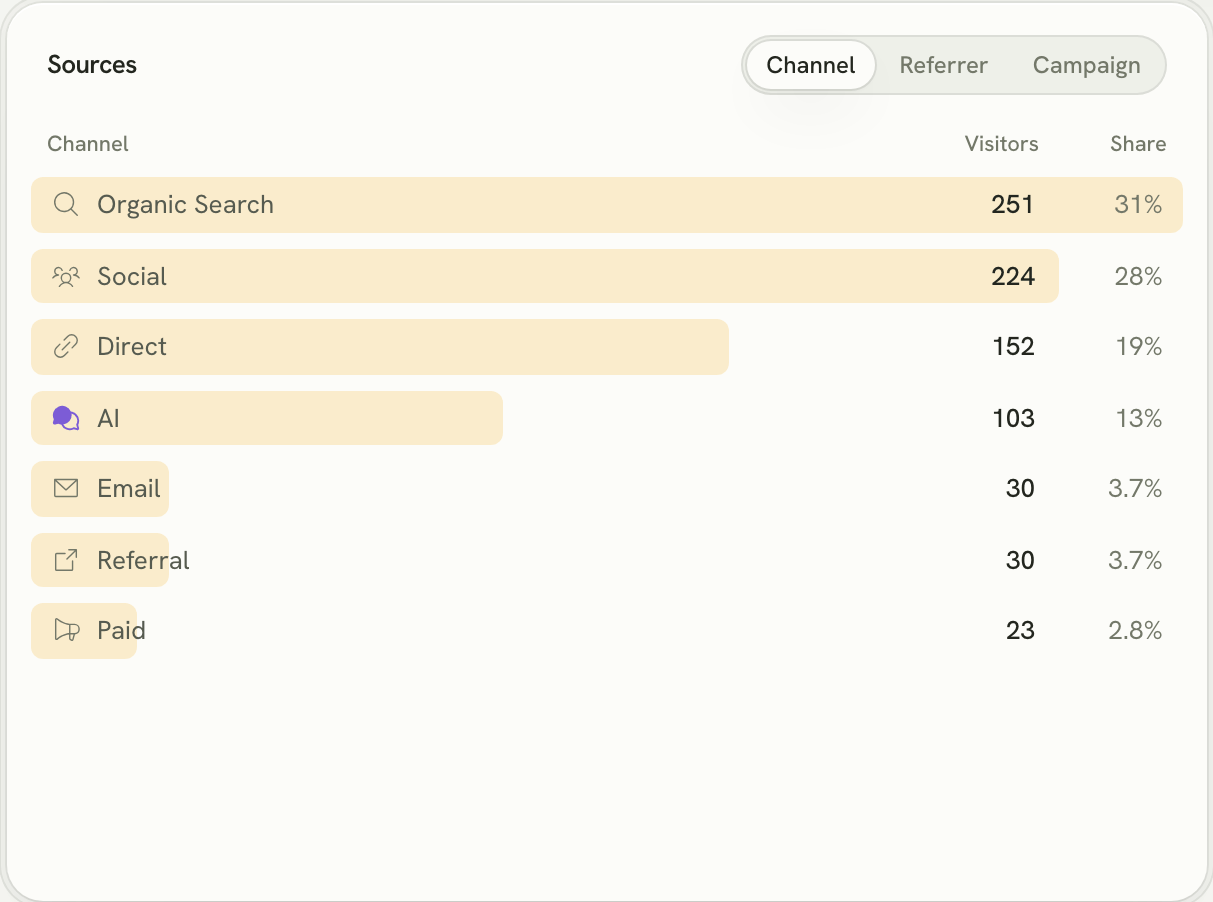
Every visitor's real source, with AI as its own channel
Lantern sorts traffic into Organic Search, Social, Direct, AI, Email, Referral and Paid, and lets you drill into the exact referrer or UTM campaign. AI assistants get their own channel, so the visitors ChatGPT, Perplexity, Gemini and Claude send you sit right next to Google, not hidden in a list of referring blogs. For a founder in 2026, that line is often the fastest-growing one on the page.
Know whether AI is reading your site
An assistant can only recommend you if its crawler has read your pages. Crawlers don't run JavaScript, so script-only analytics never see them. Lantern adds a few lines on your server and reports every AI bot by the company that runs it, split into training crawlers, AI search indexers and live fetches made to answer someone's question right now.
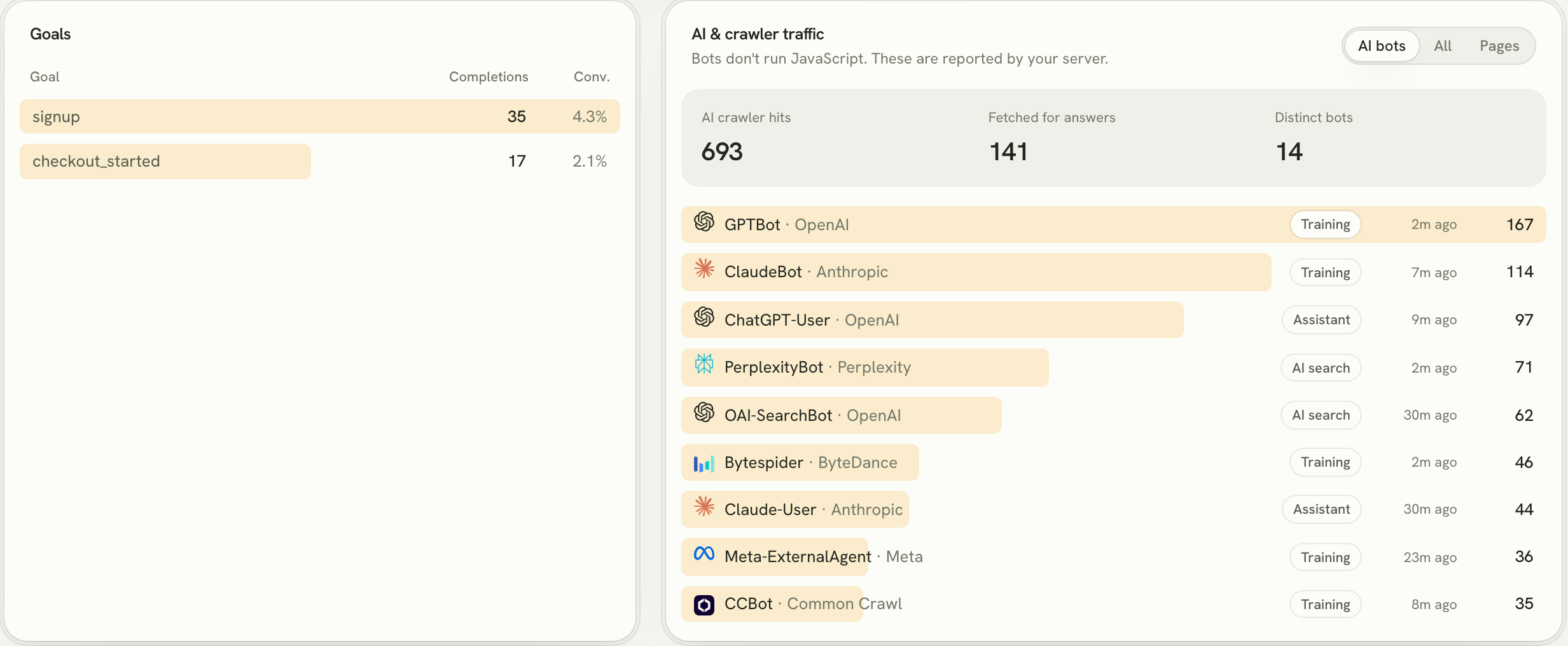
Goals that set themselves up
Paste Lantern's setup prompt into Claude Code, Codex or Cursor. Your coding agent installs the script, reads your code to find your sign-up, checkout and activation points, and adds those goals for you. You get conversion rates per channel on day one, without a tag manager or an event spreadsheet. You can also add a goal yourself with one attribute on a button.
One visitor, from first visit to sign-up
Cookieless tools count each visit on its own, so when someone finds you on Reddit on Monday and comes back to sign up on Friday, Reddit gets nothing and "Direct" gets the credit. Lantern keeps one visitor ID in a first-party cookie on your own domain, across days and across your subdomains, so the landing page on www and the sign-up in app belong to the same person and the same source.
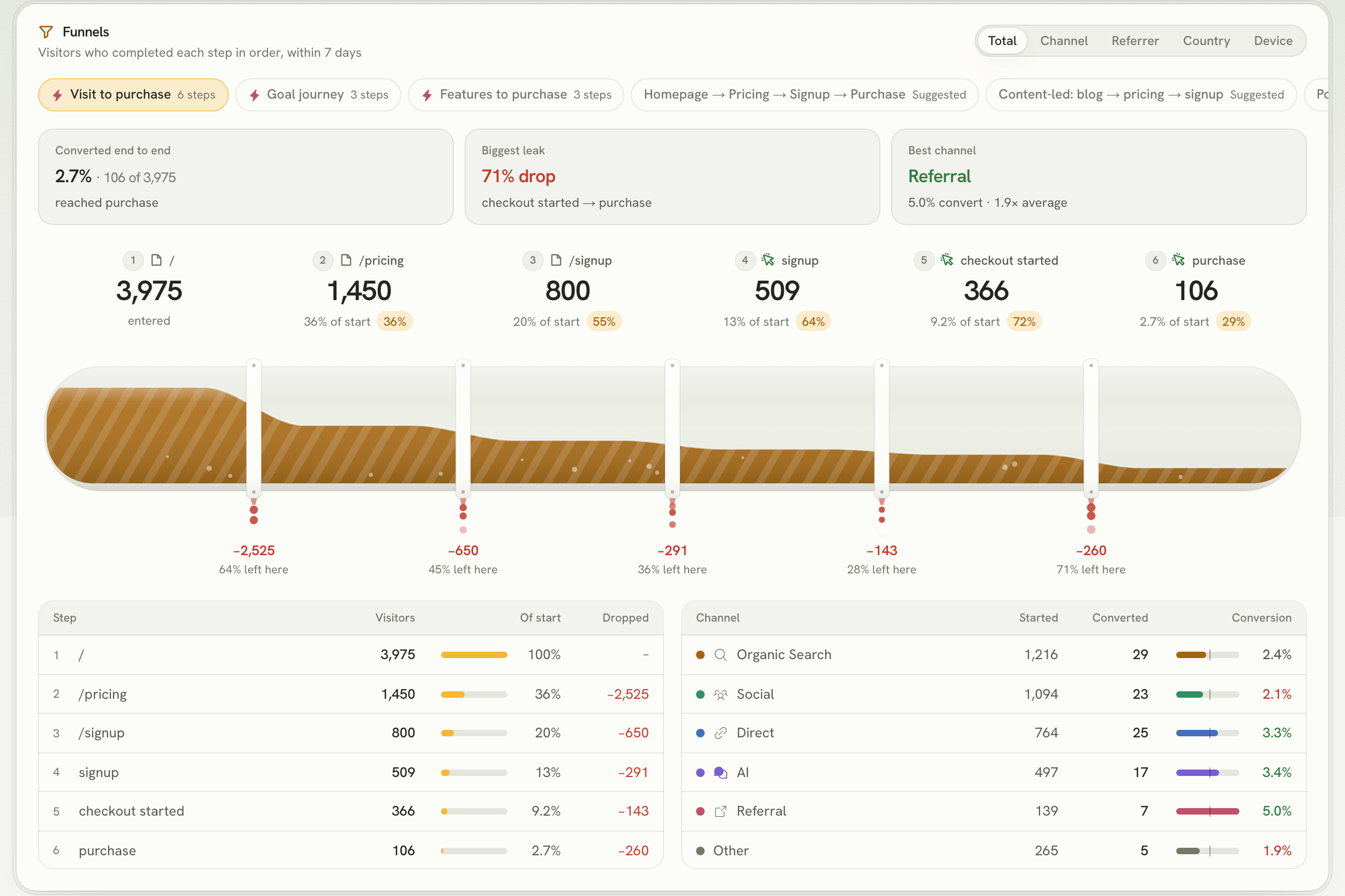
Funnels Lantern suggests for you
Lantern looks at the paths your visitors already take and suggests funnels from them. Each one runs on the last 90 days the moment you save it, so you see the drop-off at every step, the biggest leak, and which channel converts best, straight away.
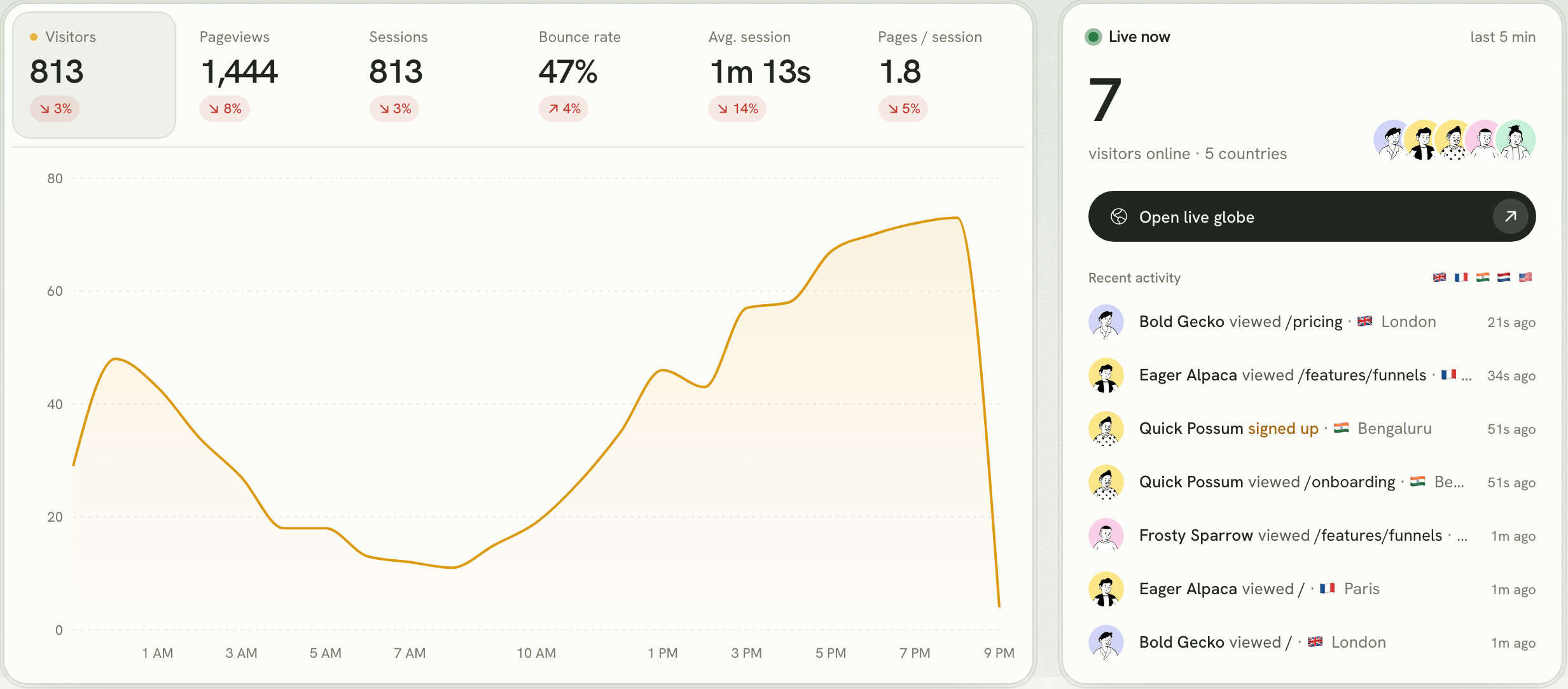
Watch a launch land, live
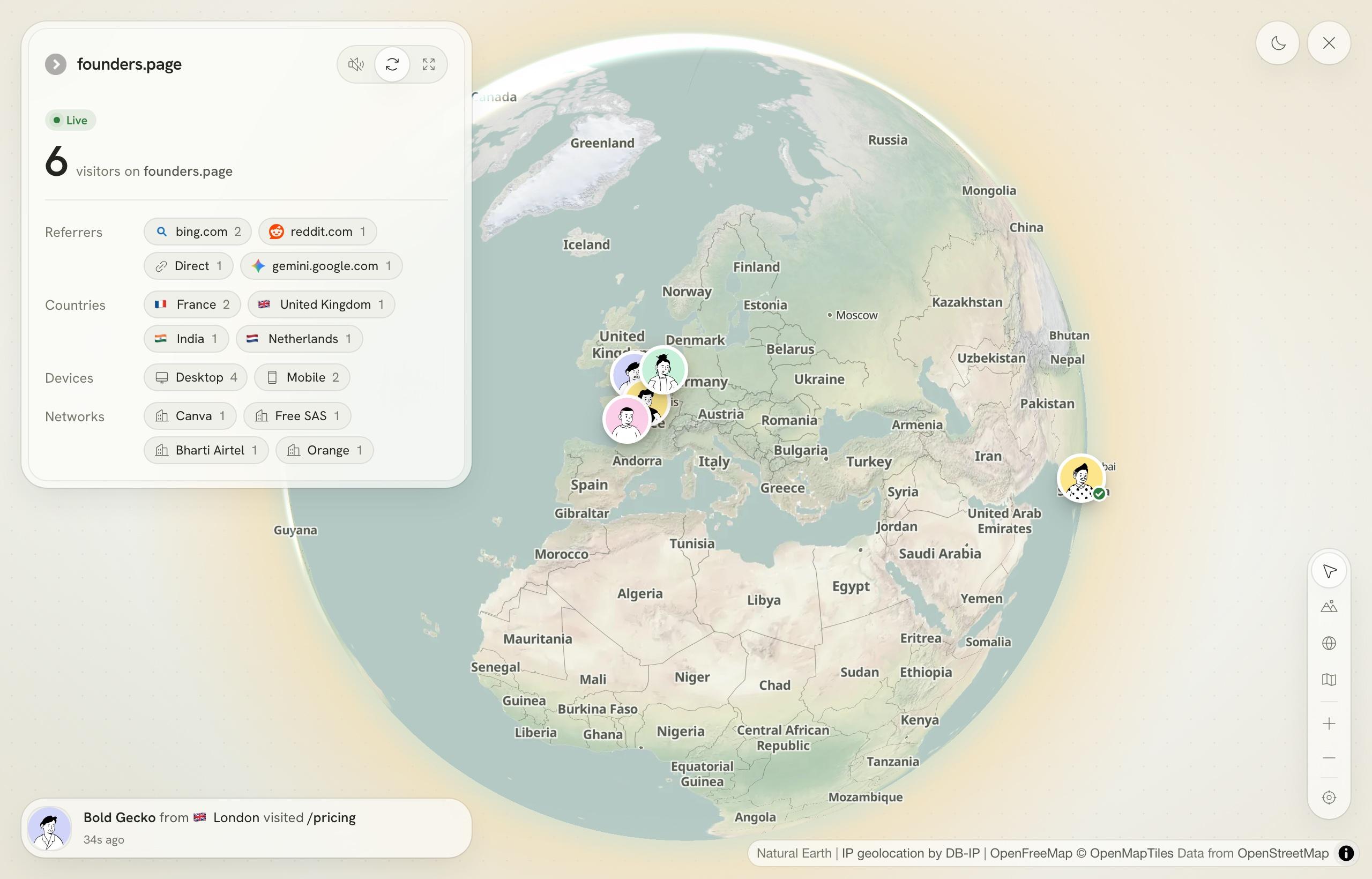
The live view puts everyone on your site on a globe, with the page they're on, where they came from, their country, device and network. When someone signs up, you see it happen. It's the screen founders keep open on launch day.
Built for Brave, Arc and ad blockers
Founders' audiences are full of developers, and developers browse with Brave, Arc and uBlock Origin. Those block third-party cookies and any script loaded from a known analytics domain, which on a technical audience can hide a fifth or more of your visitors. GA4 is the first thing they block.
Lantern is first-party on both counts. The script is served from your own domain through a single rewrite, part of the normal setup, so blocklists see your site, not an analytics vendor. And the visitor ID lives in a first-party cookie on your domain, never a third-party one, so browsers that wipe cross-site tracking leave it alone. The visitor who arrives in Brave from a Hacker News thread is counted, and still recognised when they come back to sign up.
A Monday email instead of another tab
Every Monday Lantern emails you last week's visitors, visits from AI, top sources and goals for each of your sites, so you know how the week went without opening anything.
Price
Plans start at $8 a month for 10,000 pageviews on one site, and Growth covers up to 30 sites from $17. Pricing is by traffic only, every feature is on every plan, and yearly billing gives you two months free. Every account starts with a 7-day free trial, no card needed.
The other eight, and where each falls short for founders
2. DataFast
DataFast is the tool closest to Lantern in spirit: built for founders, focused on revenue by channel, with payment-provider integrations, a live map, funnels and AI bot tracking. If syncing revenue straight from Stripe is your single must-have today, it's a strong pick. Lantern starts lower ($8 against $9), suggests funnels from your real traffic, sends a Monday summary, and is set up by your coding agent, goals included.
3. Plausible
Open source, cookieless and hosted in the EU, with a clean one-page dashboard from $9 a month or free to self-host. It's the default choice for private visit counts. The trade-off for a founder is the cookieless design: Plausible can't recognise a returning visitor, so it can't connect the channel that found someone to the day they sign up. It also only sees visitors who run JavaScript, so AI crawlers are invisible to it.
4. Fathom
A polished, privacy-first paid tool, cookieless, with an EU isolation option, from about $15 a month. Like Plausible, it's built to count visits privately, not to trace a customer back to the channel that first found them.
5. PostHog
A product analytics suite: web analytics, session replay, feature flags, experiments and surveys, with a generous free tier. It's excellent at what users do inside your app. For "which channel brings my customers?" it's heavy: more setup, more concepts, and costs that grow with each product you turn on. Plenty of founders run PostHog inside the app and Lantern for acquisition.
6. Umami
Open source, light and easy to self-host, with a hosted cloud version too. A good fit for developers who want simple stats on their own server. You get the basics, and you look after the server, the database and the upgrades.
7. Simple Analytics
A Netherlands-based tool that stores no personal data and needs no cookie banner, with simple dashboards and an AI assistant for questions. It doesn't track unique visitors over time, so it can't attribute a sign-up to an earlier visit.
8. Matomo
The most complete GA4 replacement you can own: open source, self-hosted or cloud, with deep reports and plugins for heatmaps and session recordings. It also brings GA4's main problem for founders: a lot to learn and maintain before it answers the five questions above.
9. Google Analytics 4
Free, and able to answer almost anything, if you know where to look. In practice founders struggle with it: AI assistants land in Referral next to every blog that linked to you, reports need configuring before they mean anything, and consent rules and ad blockers cut into the data. GA4 is the tool most founders start with and the one most of them leave. Here's how its alternatives compare if that's where you are.
Feature comparison
| Lantern | DataFast | Plausible | Fathom | PostHog | GA4 | |
|---|---|---|---|---|---|---|
| Returning visitors tracked across days | Yes | Yes | No | No | Yes | Yes |
| Sees AI crawlers | Yes | Yes | No | No | No | No |
| Script and cookie on your own domain | Yes, by default | With proxy setup | No cookie | No cookie | With proxy setup | No |
| Self-host | No | No | Yes | No | Yes | No |
| Starts at | $8/mo | $9/mo | $9/mo | ~$15/mo | Free tier | Free |
How to choose in one minute
- You sell something and want to know which channels bring customers, ChatGPT and other AI assistants included: Lantern.
- Revenue synced from Stripe is the one thing you need today: DataFast.
- You only need a private visit count: Plausible, Fathom or Simple Analytics.
- You need session replay and feature flags inside the product: PostHog, with Lantern for acquisition.
- It must run on your own server: Umami for simple, Matomo for depth.
Set up Lantern in two minutes
- Create a free account and add your website. Lantern picks your time zone from your browser.
- Copy the setup prompt and paste it into Claude Code, Codex or Cursor. Or paste the one-line script into your site's head.
- Open your site in another tab. You'll see yourself appear on the live globe within seconds.
Whichever tool you choose, tag the links you share with UTM parameters (here's how), and judge channels by where customers first came from, not only their last click (here's why).
Questions founders ask
Is Google Analytics enough for a startup?
It's free and powerful, but it takes real setup to answer founder questions, it files AI assistants under Referral, and it can't see AI crawlers. Most early teams get their answers faster from a tool built around acquisition, like Lantern.
Can I track traffic from ChatGPT?
Yes. Lantern shows ChatGPT, Perplexity, Gemini, Claude and other assistants in their own AI channel automatically. In GA4 you need a regex filter or a custom channel group; this guide walks through it.
Do I need cookie-free analytics?
Cookie-free tools are simpler on privacy, but they can't tell that Friday's sign-up is Monday's visitor, which is the whole point of attribution. Lantern uses a first-party cookie on your own domain, never a third-party one, which is also why privacy browsers like Brave and Arc don't strip it. Lantern never sells your data.
What does Lantern cost once my traffic grows?
Pricing only goes up with pageviews, and every plan has every feature. You're reminded well before you reach your plan's limit, and visits keep being counted even if you go over.